
ClawBrand AI Review: Deploy Your Own AI Brand Team for Photorealistic Mockups in 60 Seconds
ClawBrand AI is built for the part of branding most founders dread: creating consistent, agency-quality visuals on a deadline. When you’re launching a product, building a sales page, running ads, or posting to social, you need mockups constantly—and waiting on designers (or wrestling with template tools) can kill momentum.
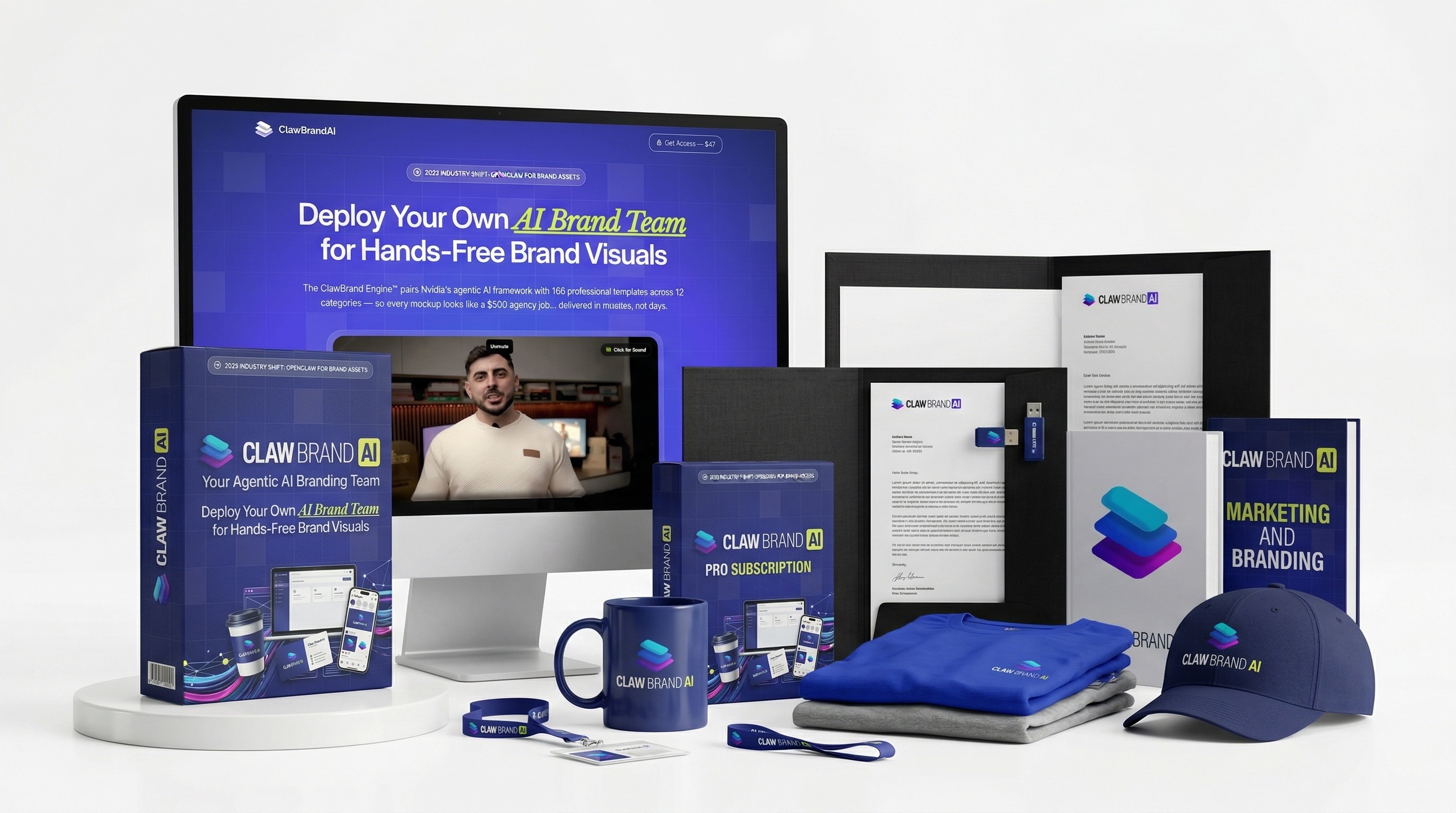
Instead of being “just another AI image generator,” ClawBrand AI is an autonomous branding crew. It pairs Nvidia’s agentic OpenClaw framework with 166 professional templates across 12 categories so your brand assets stay consistent while your mockups generate fast—claimed in under 60 seconds.
The promise is simple: upload your logo, brand colors, and tagline once, then let the system auto-apply your brand kit across new mockups in a repeatable design system. If you’ve been stuck in the designer dependency cycle (pay, wait, revise, pay again), this review breaks down how ClawBrand AI aims to replace that bottleneck.
Quick Verdict
ClawBrand AI is best for founders, agencies, and creators who need frequent on-brand visuals (web + print) without designer back-and-forth. It’s not designed to be a “lottery generator”; it’s designed to run a structured brand production pipeline using templates, saved brand settings, and coordinated AI agents.
What Is ClawBrand AI?
ClawBrand AI (also referred to as the ClawBrand Engine™) is a platform that helps you “deploy your own AI brand team” for hands-free brand visuals. The core idea is to stop thinking in terms of single images and start thinking in terms of a repeatable brand system.
According to the product concept, the engine combines Nvidia’s agentic AI framework with a library of 166 professional templates spanning 12 categories. It also uses a Brand Kit—your saved logo, brand colors, and tagline—so the system can generate consistent branding mockups every time you request new scenes.
Instead of needing additional tools (like OpenClaw setups, Canva workflows, or manual PSD resizing), you use the ClawBrand interface to generate, export, and reuse visuals from a growing mockup library.
Key Features of ClawBrand AI
Below are the standout features that define what ClawBrand AI is trying to solve: brand consistency, speed, and reducing the dependency on designers and generic AI outputs.
1) Nvidia OpenClaw Agentic Framework (Multi-Agent Coordination)
Many AI tools act like a single “black box” that you prompt and hope for the best. ClawBrand AI’s approach is different: it uses multiple specialized AI agents working together.
- Brand Identity Agent: applies your logo, colors, and style consistently.
- Mockup Generation Agent: creates photorealistic mockups from your assets.
- Scene Creation Agent: builds custom environments and real-world backgrounds.
- Asset Automation Agent: handles variations and exports simultaneously.
- Brand Memory Agent: remembers your assets and preferences so you don’t repeat setup work.
2) 166 Professional Templates Across 12 Categories
ClawBrand AI includes a library designed for real branding work—things you typically need for sales pages, ad creatives, product listings, and campaign assets.
- 12 categories designed to cover common brand and product mockup needs.
- Examples mentioned include devices, apparel, packaging, signage, and more.
- Templates range from simple product scenes to more premium, lifestyle-driven contexts.
3) SceneScaper AI for Custom Scene Building
If the template library doesn’t perfectly match your use case, ClawBrand AI includes SceneScaper AI. Instead of forcing you into a “pick from a few options” workflow, you can describe a scene in plain text.
This aims to give you flexibility without requiring you to manually design environments or build backgrounds from scratch.
4) Brand Kit: Upload Once, Apply Forever
The Brand Kit feature is one of the most practical parts of the system. You upload your:
- logo
- brand colors
- tagline
Then the system “locks in” those elements so every future mockup pulls from the same brand settings automatically. That’s the difference between a chaotic AI output and a consistent brand system.
5) Web + Print Exports From the Same Generation
One of the constant problems with mockups is format mismatch. You generate something for social, then realize the banner print needs a different resolution; or you export a print asset that looks blurry on the web.
ClawBrand AI addresses this with exports in:
- 1200px web optimized files
- 3000px print-quality exports
Both derived from the same generation process, intended to reduce manual resizing.
6) Asset Manager + Drag-and-Drop Organization
Instead of cluttered folders and manual versioning, the platform includes an Asset Manager with:
- drag-and-drop uploads
- tags
- favorites
- usage tracking
That matters because most teams (even small ones) fail not because they can’t generate visuals—but because they can’t easily reuse the right assets quickly.
7) BG Removal for Clean Backgrounds
ClawBrand AI includes BG Removal so you can produce clean, transparent backgrounds with one click. This can be useful when you want mockups for:
- sales pages
- ads
- print proofs
It’s also positioned as a way to avoid Photoshop-style workflows for basic background cleanup.
8) Agency Dashboard + Client-Ready Operations
ClawBrand AI includes an agency dashboard style interface meant for team or client operations. Features described include adding team members, managing clients, and storing client brand settings.
It also provides a saved mockup library with search and download history—so your visual portfolio grows automatically with every generation.
Benefits & Use Cases (Who This Is For)
ClawBrand AI’s design is clearly influenced by one common reality: brand visuals aren’t optional. They’re required for every launch, campaign, and content pipeline.
So the real question becomes: will ClawBrand AI make your workflow faster and more consistent? Let’s break down the likely outcomes by use case.
Benefit 1: Replace Designer Bottlenecks With Instant Mockups
If your current process is something like:
- post on Fiverr
- wait days
- receive drafts
- request revisions
- pay more and delay the launch
ClawBrand AI is trying to eliminate that cycle by letting you generate mockups on demand. The pitch is that you can get polished visuals in under 60 seconds—so your marketing schedule doesn’t depend on someone else’s timeline.
Benefit 2: Stop Looking “Template Generic”
Many Canva-based or one-off generator mockups look generic because the inputs and outputs aren’t consistent with a system. ClawBrand AI attempts to solve that with its Brand Kit and multi-agent identity application.
Instead of getting “whatever the generator felt like,” you’re applying a saved brand system to new scenes automatically.
Benefit 3: Generate Visuals for Both Web and Print
Instead of producing one output for social and a totally different asset for print, you can generate once and export in web-optimized and print-quality sizes. That’s especially helpful for:
- product pages
- paid ads
- trade-show displays
- pitch decks and proposals
- packaging mockups and supplier briefs
Benefit 4: Build a Visual Library You Can Search
Over time, mockups become a library: brand boards, product shots, campaign scenes, stationery proofs. ClawBrand AI’s Saved Mockup Library and search aims to stop the “digging through folders” problem.
You can also create variations from existing mockups—so your workflow evolves into a repeatable production process.
Real User Scenarios / Examples
To make this feel concrete, here are a few example scenarios that match the kinds of templates and exports described.
Scenario A: DTC Founder Launching a New Hoodie Drop
A founder has a new hoodie SKU for an upcoming sale. They need a product hero image for Shopify, a set of ad creatives for Meta, and a couple of print-ready images for the packaging inserts. With ClawBrand AI, they can upload the logo and color palette in the Brand Kit, then choose a premium apparel scene and generate multiple variations quickly—then export both web and print versions without redoing the design process.
Scenario B: Affiliate Marketer Building a Sales Page
An affiliate marketer wants to update their landing page and add “real brand” proof visuals. Instead of commissioning custom mockups or relying on generic AI images, they generate brand identity boards and stationery-style mockups using the same Brand Kit. This provides consistency across the page (logo placement, colors, tagline) and speeds up landing page iterations while testing traffic sources.
Scenario C: Small Creative Agency Onboarding Client Work
An agency wants to deliver mockups to clients faster without asking for designer revisions every time. They can store each client’s brand kit (logo/colors/tagline), then generate ready-to-use visuals for campaigns. The agency dashboard and saved library concept supports client-ready asset production, potentially reducing the time spent managing deliverables.
Scenario D: Print-on-Demand Store Needs Multiple Product Listings
A POD store needs new product images for drinkware, tees, and tote bags frequently. Instead of paying for photoshoots or relying on inconsistent generator outputs, they use ClawBrand AI templates to produce consistent product mockups and export web + print versions to match listing needs and any promotional materials.
Demo Video
Pros & Cons of ClawBrand AI
Every tool has tradeoffs. Here’s an honest look at what seems strong—and what you should think about before relying on it for your entire branding workflow.
Pros
- Brand consistency through Brand Kit: logo, colors, and tagline applied across outputs.
- Fast mockup generation: positioned as under 60 seconds per mockup.
- Multi-agent system: aims to coordinate tasks so outputs are more structured than single-model generators.
- 166 templates across 12 categories: covers common product and branding needs.
- Web + print exports: 1200px and 3000px exports from the same generation.
- Saved mockup library with search: helps you reuse and track your work.
- BG removal included: one-click transparent backgrounds for flexible use.
Cons
- Template-based starting point: while SceneScaper AI helps, you’ll still get best results when your input matches common scene patterns.
- Quality may depend on your Brand Kit setup: if your logo files/colors/tagline aren’t optimized, outputs may still look less polished.
- Learning the workflow takes time: even though it’s marketed as simple, any new system requires a short onboarding period.
- Agency usage depends on client asset readiness: you’ll need to gather client branding elements in a consistent format for the best results.
ClawBrand AI vs Alternatives (What’s Different?)
To understand where ClawBrand AI fits, it helps to compare the “job to be done.” Many AI tools focus on a single output type (traffic, content, booking, video creation). ClawBrand AI focuses specifically on repeatable brand visuals using a saved system.
Here are a few related alternatives (only when relevant to your needs), plus how they differ:
Alternative 1: OpenClaw-based systems
If you’re drawn to Nvidia OpenClaw concepts and multi-agent AI business automation, you might also look at:
Difference: ClawBrand AI is focused on branding mockups and visual consistency—not full end-to-end automation.
Alternative 2: Design-focused or generic AI content tools
Many platforms that generate creative assets can feel like a “slot machine” output—especially when you need strict brand consistency. If your main pain is replacing templates and consistent mockups, ClawBrand AI’s Brand Kit approach is the key differentiator.
Alternative 3: Video/content automation tools
If your bottleneck is social videos rather than static brand mockups, some tools may better align with that outcome, such as:
Difference: those are aimed at content creation for social—not brand mockup production pipelines.
Alternative 4: Templates and funnel builders
If you mainly need landing page builds and conversion systems, you might explore tools built around funnels and traffic. For example:
Difference: those help your funnel structure, but they won’t solve your brand visual production system.
How ClawBrand AI Works (Step-by-Step)
The ClawBrand AI workflow is structured to be repeatable. Here’s the process as described:
Step 1: Upload Your Brand Kit (Once)
You upload your logo, set brand colors, and save your tagline. This is the foundation that ensures consistency across every mockup you generate afterward.
Step 2: Pick a Scene or Use SceneScaper AI
You browse 166 templates across 12 categories. If you want something more specific, SceneScaper AI can build a custom environment from a text description.
Step 3: Generate Mockups (Under 60 Seconds)
Click generate and your AI brand team applies your logo, brand colors, and stylistic elements to the selected scene. The result is a photorealistic mockup you can download and publish immediately.
Step 4: Export for Web and Print
Use the same generation to export web-ready 1200px files and print-quality 3000px files. This reduces the “generate twice” problem.
Who Should Buy ClawBrand AI?
ClawBrand AI seems like a strong fit if you match one (or more) of these profiles:
- Founders who launch often and need brand visuals on a schedule.
- Creators who need premium visuals for pitch decks, products, or offers.
- Agencies that deliver mockups and need a repeatable pipeline across clients.
- DTC / POD businesses that need ongoing product listing and ad creatives.
- Anyone who’s tired of paying for revisions and waiting for turnaround times.
Who Might Want to Think Twice?
Even with a strong system, it’s worth being realistic. You might want to be cautious if:
- You only need one or two mockups per year (then ROI is harder to justify).
- Your brand assets are incomplete or inconsistent (logo/color files might need cleanup first).
- You want fully custom, handcrafted art direction every time (a system can still generate premium scenes, but it’s driven by templates and structured agents).
CTA
Conclusion / Final Opinion
ClawBrand AI makes a compelling case that your branding bottleneck isn’t a lack of creativity—it’s a lack of a repeatable design system. When your launches, ads, emails, and social posts all depend on mockups, waiting on designers or settling for generic outputs is a tax you pay repeatedly.
With its Brand Kit that’s uploaded once, 166 professional templates, web + print export formats, and multi-agent coordination inspired by Nvidia’s OpenClaw framework, ClawBrand AI aims to deliver consistent, photorealistic visuals in under 60 seconds—so you can stop treating mockups like a project and start treating them like production.
If you’re ready to break the designer dependency cycle and build a visual pipeline that keeps your brand looking professional across every channel, ClawBrand AI is worth testing. Hit the button above to get access and start generating on-brand mockups on your schedule.